In this guide
- What Are Built-In Bookshelves?
- 8 Built-In Bookshelf Ideas That Work in Real Homes
- How Deep Should Built-In Bookshelves Be?
- How Far Apart Should Bookshelves Be?
- How Do You Stop Built-In Shelves Sagging?
- Real Project: Shelving Under a Sloping Ceiling
- What Materials and Finishes Suit Built-In Bookshelves?
- What Affects the Cost of Built-In Bookshelves?
- Built-In or Freestanding Bookcase: Which Is Better?
- Common Questions About Built-In Bookshelves
- Where to Start With Built-In Bookshelves
Built-in bookshelves are shelves made to measure and fixed into a room, so they fill a wall, an alcove or an awkward space from floor to ceiling instead of standing in front of it. Examples include alcove bookcases either side of a chimney breast, shelving around a TV or fire, and bookshelves built under a sloping ceiling. We design, make and fit built-in bookshelves across Warrington, Cheshire and the North West, with a free design visit, 3D drawings and a 10-year guarantee.
What Are Built-In Bookshelves?
Built-in bookshelves are fitted shelving units scribed to the walls, floor and ceiling of a room, so there are no gaps around them and nothing to dust on top. A freestanding bookcase is a separate piece of furniture. A built-in bookcase is part of the room.
Built-in bookshelves usually combine 3 parts:
- Open shelving for books, photos and display pieces.
- Closed cupboards below, at around 500mm to 900mm high, for the things you would rather not see.
- Integrated details such as LED lighting, a desk, a window seat, a TV space or an electric fire.
8 Built-In Bookshelf Ideas That Work in Real Homes
The 8 built-in bookshelf ideas we fit most often are alcove bookcases, shelving around a TV or fire, lit display shelving, full library walls, shelving under a sloping ceiling, bookshelves around a door, under-stairs shelving and a built-in desk with shelves above. Each one suits a different wall and a different amount of space.
1. Alcove Bookcases Either Side of a Chimney Breast
The two alcoves beside a chimney breast are the classic home for built-in bookshelves. They are already the right depth, and cupboards below with open shelves above suit most living rooms. Our guide to alcove cabinetry covers proportions and unequal alcoves in detail.
2. Shelving Built Around a TV and Fire
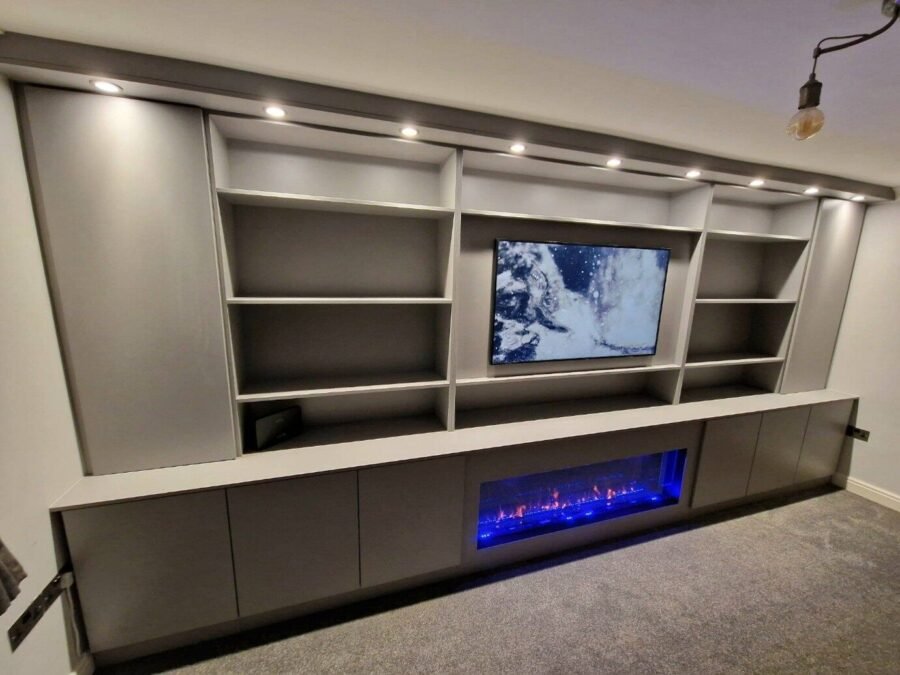
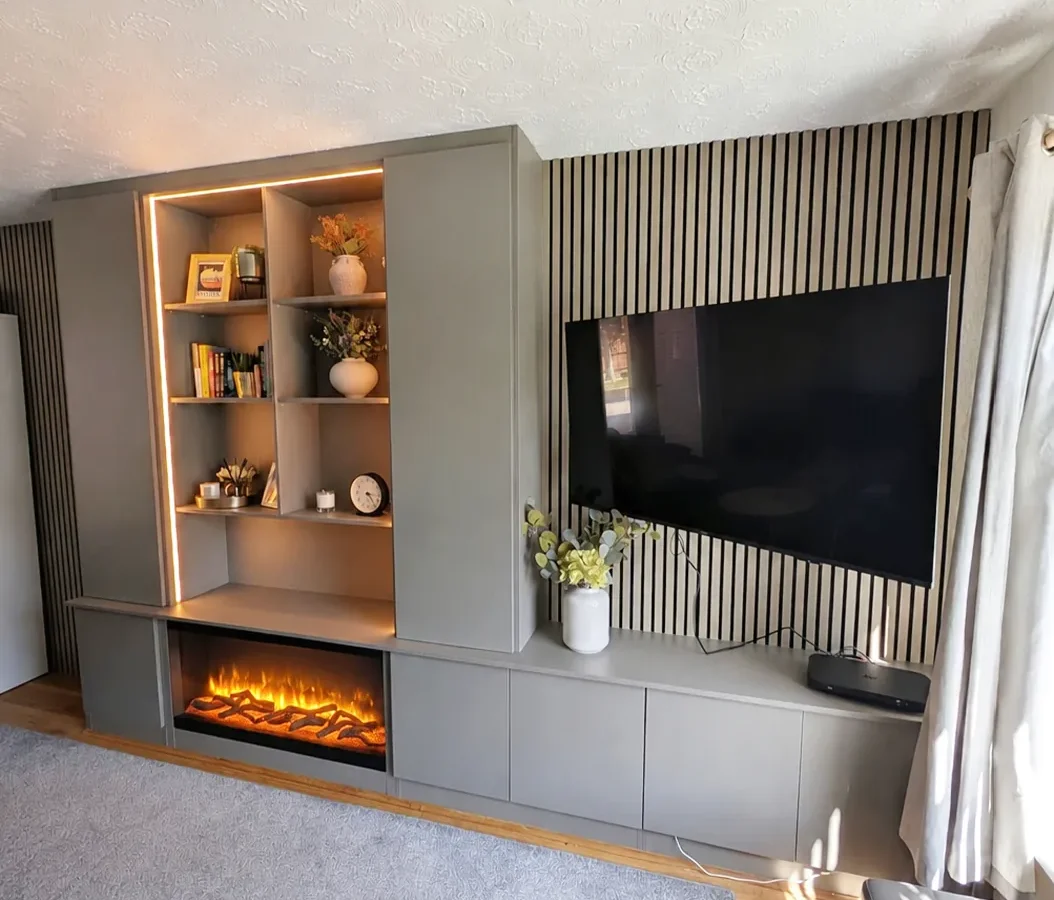
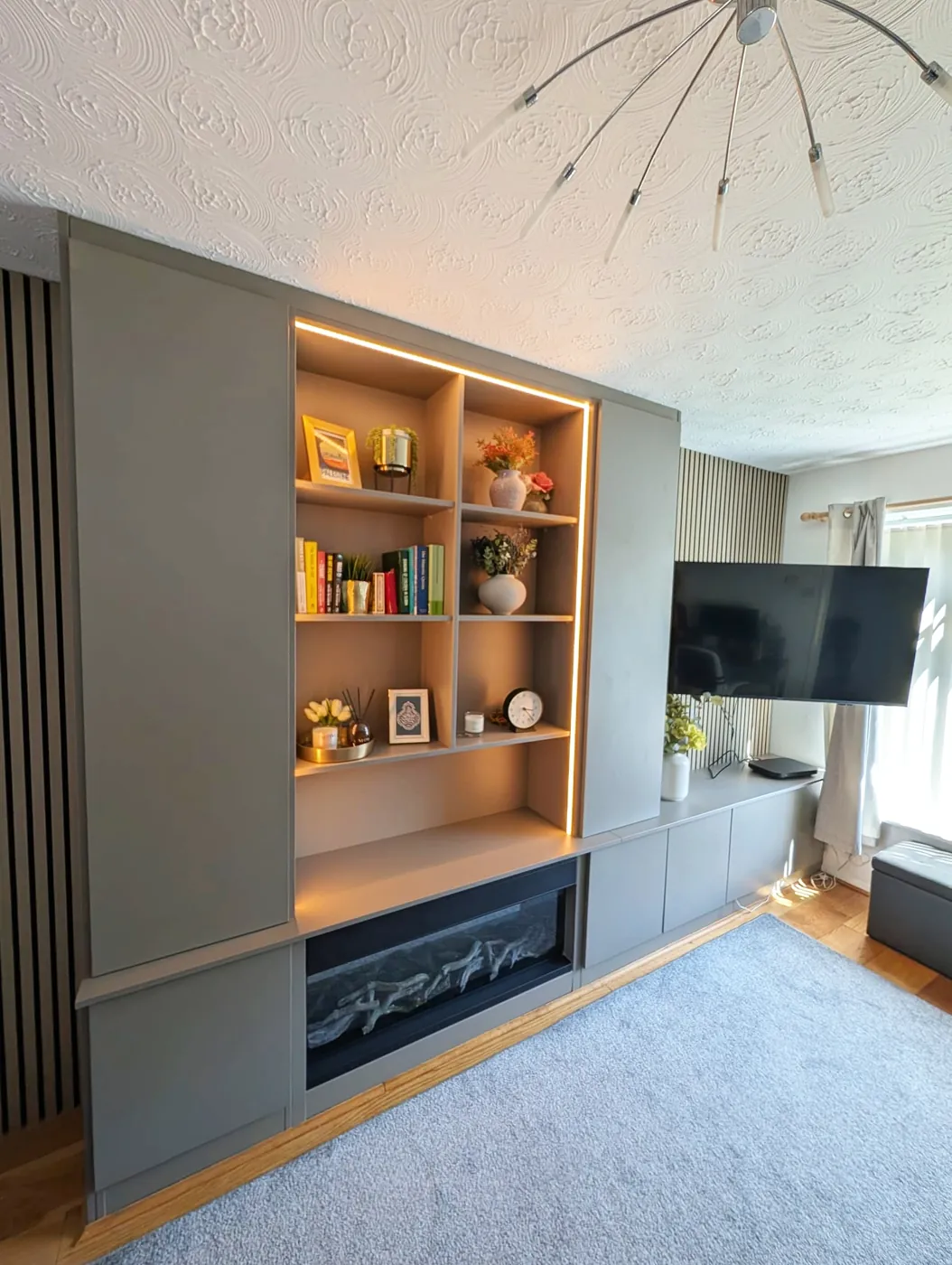
Book shelving on one side and a TV on the other turns one wall into storage, display and entertainment. The photo at the top of this guide is a real example: a tall cupboard, lit open shelves and an electric fire, with the TV on a slatted panel beside it. A full media wall takes the same idea across the whole wall.
3. Lit Display Shelving
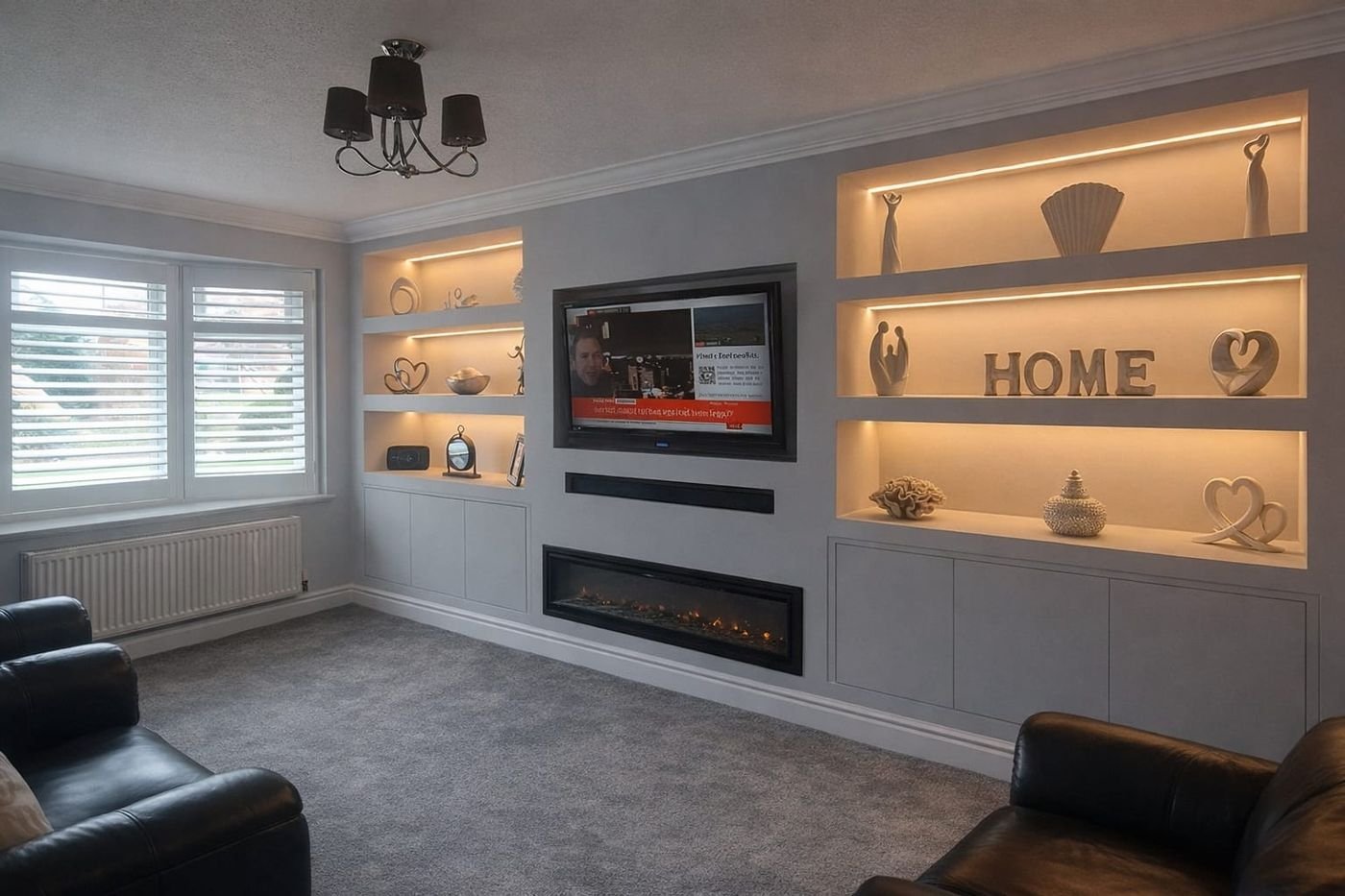
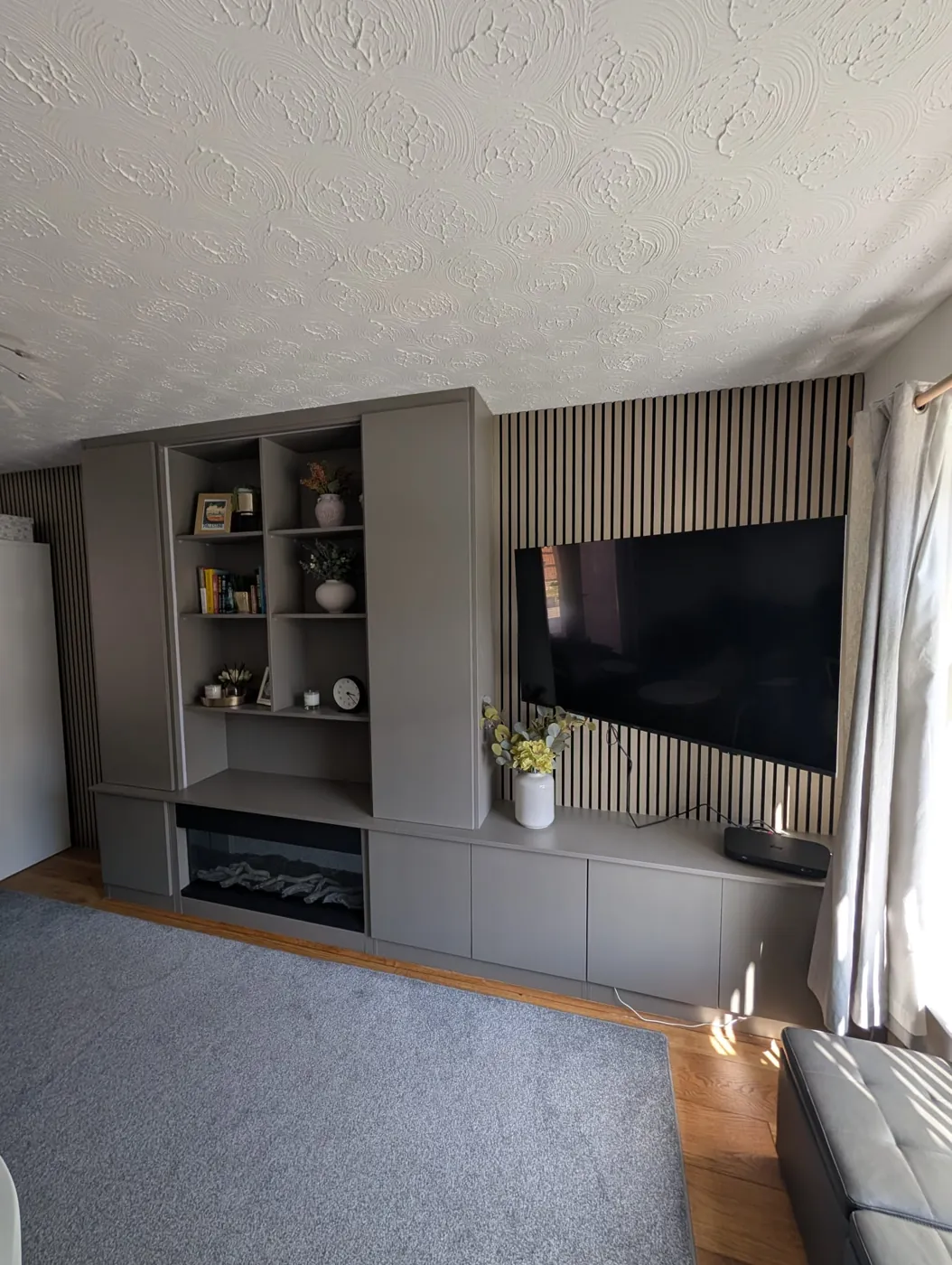
LED strip lighting set into the shelf edges or the unit frame lifts book spines and display pieces in the evening. Warm white at around 2,700K to 3,000K suits most living rooms. The lighting is wired before the unit is finished, so there are no visible cables.
4. A Full Library Wall
A floor-to-ceiling library wall holds hundreds of books in about 300mm of depth. It suits a long wall in a living room, dining room or landing. Closed cupboards along the bottom stop the wall looking cluttered.
5. Bookshelves Under a Sloping Ceiling
A sloping ceiling in a loft room or above a staircase wastes space that freestanding furniture cannot reach. Built-in shelving follows the angle, with tall bays where the ceiling is high and short bays where it drops. Our guide to fitted furniture for sloping spaces explains how we measure and build to an angle.
6. Shelving Around a Door or Window
Shelving that frames a doorway or a window turns a wall with no obvious use into storage. A window seat between two bookcases is a popular version in bay windows and box rooms.
7. Under-Stairs Bookshelves
Open shelving under the stairs suits a hallway or an open-plan living room, where the space is on show. Our under-stairs storage ideas compare shelving, pull-outs and cupboards.
8. A Built-In Desk With Shelves Above
A desk with bookshelves above it gives a home office storage without taking up floor space. Our guide on planning a fitted home office covers desk heights, sockets and shelving.
How Deep Should Built-In Bookshelves Be?
Built-in bookshelves are usually 250mm to 300mm deep for books, and 350mm to 450mm deep where cupboards sit below. Most paperbacks need around 200mm, and most hardbacks and coffee table books need 250mm to 300mm.
- Paperbacks: about 200mm deep.
- Hardbacks and mixed books: about 250mm to 300mm deep.
- Display pieces and baskets: about 300mm to 350mm deep.
- Base cupboards: about 350mm to 450mm deep, which leaves a ledge in front of the shelves above.
How Far Apart Should Bookshelves Be?
Bookshelves are usually spaced 250mm to 350mm apart, which fits most paperbacks and hardbacks with room to lift a book out. Taller bays of 350mm to 400mm suit large books, vinyl records and display pieces.
Adjustable shelves suit a collection that changes. Fixed shelves are stronger and look cleaner, so we often mix both in one unit.
How Do You Stop Built-In Shelves Sagging?
Built-in shelves stay straight when the span between supports is kept short and the shelf is thick enough for the weight of books. Books are heavy, and a full metre of hardbacks weighs roughly 20kg to 30kg.
- Keep spans short: we usually keep each shelf to around 800mm or less between uprights.
- Use thicker shelves: a thicker shelf, or a shelf with a front lip, resists bending on wider bays.
- Fix the back edge: a shelf fixed along the back and sides carries more weight than one resting on pins.
Real Project: Shelving Under a Sloping Ceiling
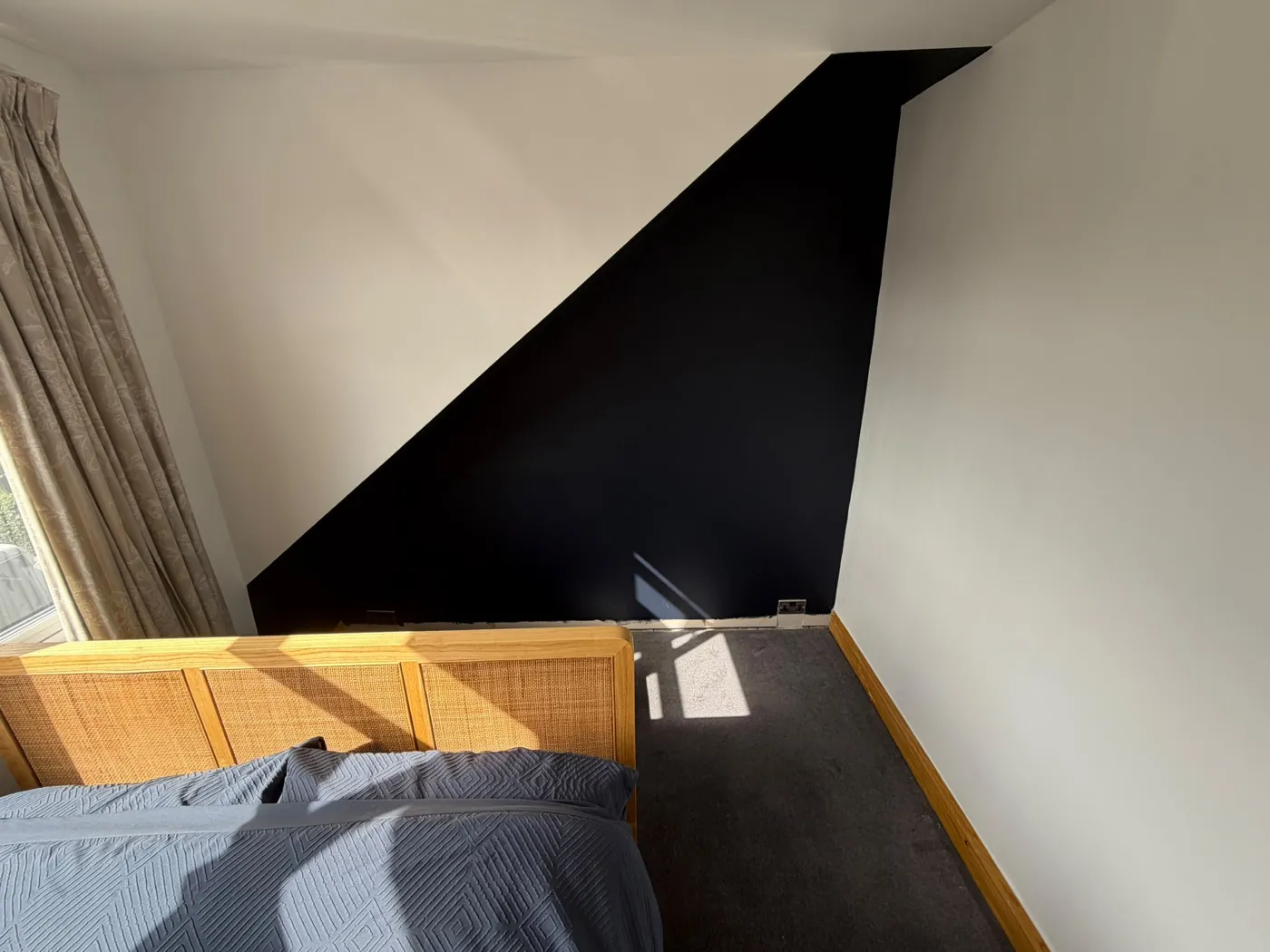
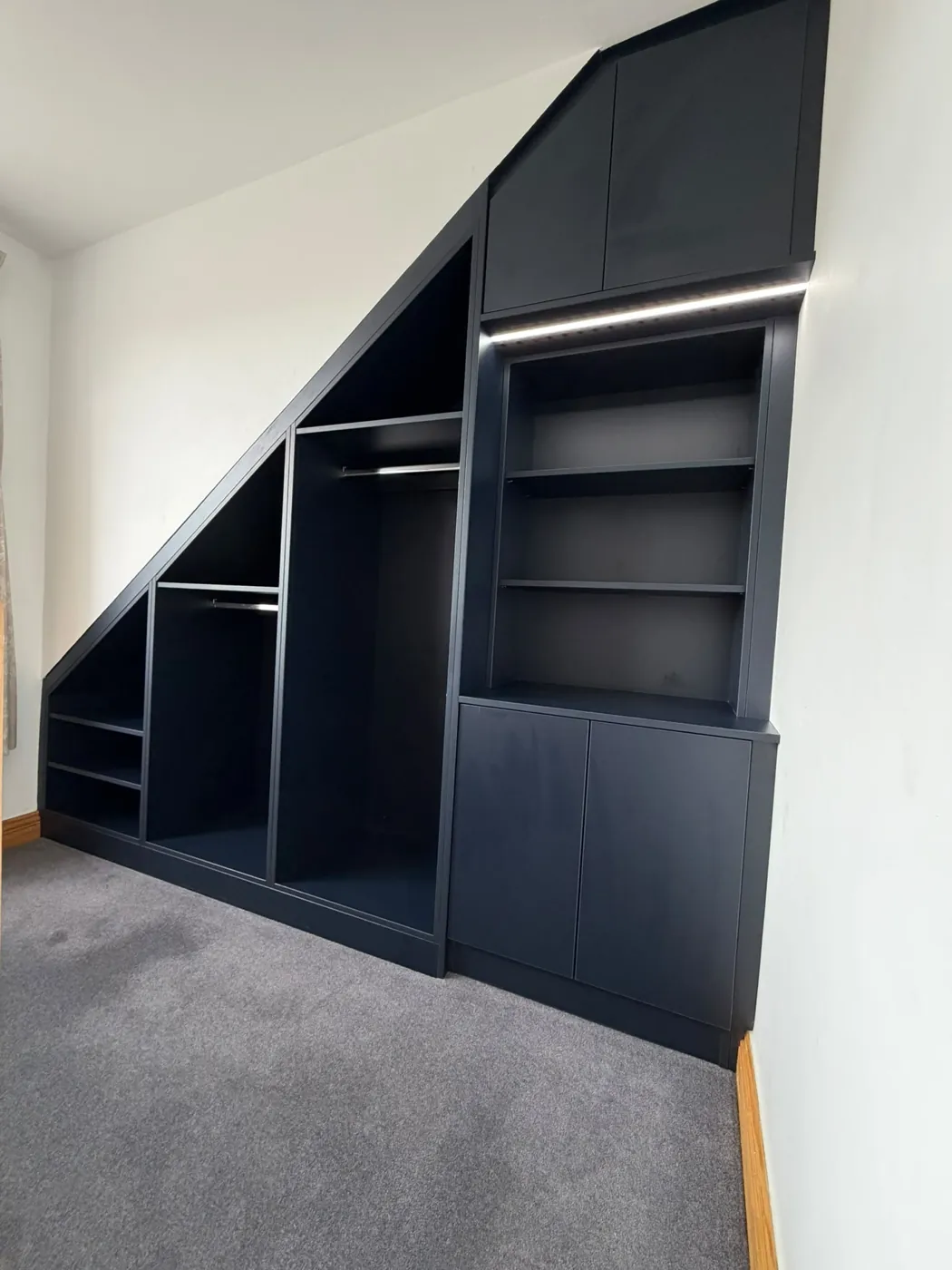
This bedroom had a steep sloping wall that freestanding furniture could not use, so we built navy shelving and hanging space to follow the angle. The tall bay holds open shelving with an LED strip above, and the low bays under the slope take hanging rails and shelves.
What Materials and Finishes Suit Built-In Bookshelves?
Most built-in bookshelves are made from MDF or plywood and finished in paint or a factory-applied colour, because both stay flat and take a smooth finish. Timber veneer and oak-effect finishes suit traditional rooms.
- Painted finishes: match or contrast with the walls, and suit period and modern homes. Examples include soft greys, navy and sage.
- Woodgrain finishes: add warmth, and suit libraries and studies.
- Two-tone schemes: a dark back panel behind lighter shelves makes books and display pieces stand out.
What Affects the Cost of Built-In Bookshelves?
Every built-in bookcase we make is bespoke, so the price depends on the size, the number of cupboards, the finish and any lighting or extras. You receive a clear, fixed quote after a free design visit.
The 6 things that change the price are:
- Size: the height and width of the wall or alcove.
- Cupboards and drawers: closed storage costs more than open shelving.
- Finish: painted and veneered finishes vary in price.
- Lighting: LED strips, switches and wiring.
- Extras: a TV space, an electric fire, a desk or a window seat.
- The room: sloping ceilings and uneven walls take longer to scribe and fit.
Built-In or Freestanding Bookcase: Which Is Better?
A built-in bookcase suits a room where every centimetre counts, while a freestanding bookcase suits a rented home or a room you plan to change soon. The table below compares the two.
| Feature | Built-in bookshelves | Freestanding bookcase |
|---|---|---|
| Fit | Scribed to walls, floor and ceiling | Gaps at the sides and top |
| Storage | Uses the full height of the room | Stops at a standard height |
| Stability | Fixed to the wall | Needs a wall strap for safety |
| Moving home | Stays with the house | Comes with you |
Floating shelves are a different thing again. They suit a few books or ornaments, but they are not designed to carry a full wall of books.
Common Questions About Built-In Bookshelves
Are built-in bookshelves worth it?
Yes, for most homes. Built-in bookshelves use the full height of a wall, leave no gaps to collect dust and are fixed securely, so they hold more and look tidier than freestanding bookcases.
Do built-in bookshelves add value to a house?
Well-made built-in shelving is often listed by estate agents as a feature, because it makes a room look finished. Simple, neutral designs appeal to the most buyers.
Can you build bookshelves on a stud wall?
Yes. On a stud wall we fix into the timber studs or add support behind the plasterboard, so the shelves carry the weight of books safely. We check the wall type on the design visit.
Can you add lighting to built-in bookshelves?
Yes. LED strip lighting can run along the shelf edges or the frame, wired to a switch, a remote or a motion sensor. It is planned at the design stage so the cables stay hidden.
How long does it take to fit built-in bookshelves?
Most built-in bookshelves are fitted in 1 to 2 days once they are made. Larger library walls and units with lighting or a fire take a little longer.
Where to Start With Built-In Bookshelves
Start with the wall, the books and display pieces you own, and anything else the wall needs to hold, such as a TV or a desk. Then book a free design visit. We measure the space with laser tools, show you 3D designs and give you a fixed quote, with no obligation. See more finished rooms in our fitted living room furniture and gallery, or call us on 07778 165587.